




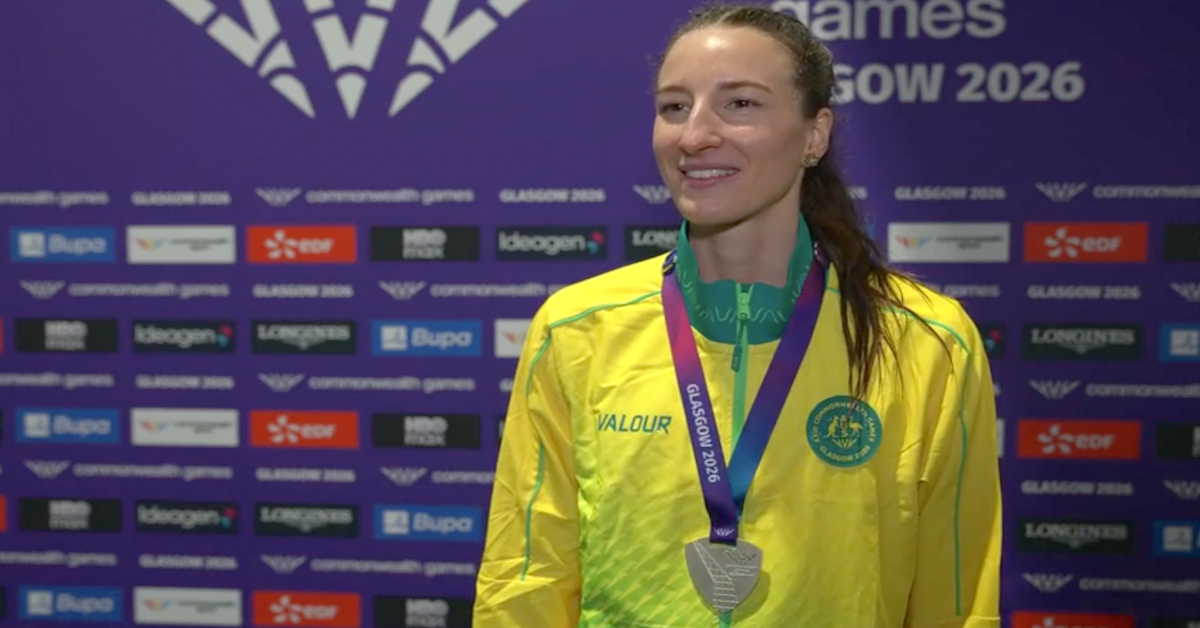
Before Nicola Olyslagers became a world champion, a two-time Olympic medallist and the first Australian woman to clear two metres in the high jump, she was a University of Sydney biochemistry student in Camperdown, balancing study, training and café work.
She studied on commutes, arranged athletics sessions around classes and worked shifts to help pay for overseas competitions. When full-time study became difficult to sustain alongside elite sport, she moved to part-time enrolment and completed the three-year degree over six years.
By the 2026 Commonwealth Games in Glasgow, the student who once revised science during her commute had become one of the world’s leading high jumpers. In rain-soaked conditions on 29 July, Olyslagers cleared 1.93 metres to win silver behind Australian teammate Eleanor Patterson, who jumped 1.96 metres.
For the reigning world champion and world No. 1, silver represented a result below the expectations surrounding her. Yet Olyslagers’ career has never been adequately explained by medal colour alone.
Café shifts funded an uncertain ambition
Olyslagers began studying biochemistry at the University of Sydney in 2015 while still trying to establish herself internationally.
Her junior results gave little indication that Olympic medals were inevitable. She missed the final at the 2014 World Junior Championships and recorded no height at the 2017 World Championships, exposing the distance between domestic promise and success on the global stage.
Without sponsorship, she worked in a café for four to five years. Her duties were focused largely on cleaning and customer service, and a six-hour shift could be followed by training. The wages helped fund flights to competitions at a time when every international opportunity had to be earned twice: first at work, then on the runway.
She has recalled imagining major meetings and Olympic competition while washing dishes. Those private visions sustained an ambition that had little financial security and no guaranteed outcome.
At 20, however, she came close to leaving athletics. Her doubts extended beyond the practical demands of travel, study and money. High jump had become central to her identity, and when the bar fell she lacked a foundation beyond the result.
As a junior, she was often better in training than in competition, a pattern she associated with pressure and fear.
Faith loosened the grip of results
Olyslagers has said her Christian faith became central during that period.
She stopped allowing athletics to determine her identity and began approaching the sport through faith, joy and service to others. Once she accepted that she would be all right without high jump, she became freer within it.
Her international results improved in the years that followed. She won bronze at the 2018 Commonwealth Games, then rebuilt her technique with long-time coach Matt Horsnell.
In 2021, she became the first Australian woman to clear two metres and won Olympic silver in Tokyo with a personal best of 2.02 metres. Mandatory quarantine after the Games gave her two uninterrupted weeks to finish the remaining work for her University of Sydney degree.
Olyslagers is uncertain whether she will return to biochemistry after athletics, but she has said the course taught her to work hard. University required her to persist through difficult material without immediate mastery, a lesson readily transferred to an event in which months of training may be rewarded by a single centimetre.
From contender to the world’s best
After marrying Rhys Olyslagers in 2022, she began competing under her married name.
She won World Championships bronze in 2023, followed by the world indoor title and a second Olympic silver medal in 2024. Her 2025 season brought indoor and outdoor world titles, the Diamond League crown and an Oceanian record of 2.04 metres.
Despite that success, her training environment has remained simple. She continues to work with Horsnell at his home, sometimes lifting weights in the garage or driveway.
Her career was shaped by crowded schedules and modest facilities, circumstances that required her to progress without waiting for ideal conditions. The café shifts, university commute and suburban training base became part of the same education in persistence.
Glasgow silver, measured differently
At Glasgow 2026, Patterson took gold and Olyslagers left with silver.
Olyslagers’ public philosophy does not require indifference to defeat. Her competitiveness remains central to her pursuit of greater heights, but she separates disappointment in a performance from her sense of identity.
This principle also informs her work with younger athletes through Everlasting Crowns and her mentoring of those moving from junior sport into university and senior competition. She understands the uncertainty of that transition, the pressure to perform, the loss of familiar structures and the need to decide what matters beyond results.
Olyslagers has set her sights on a new personal best as she works towards the 2028 Los Angeles Olympics. The medals may follow, but her career has already established a more enduring measure of success.
The bar can record how high she jumps. It cannot decide who she is.
Published 31-July-2026