


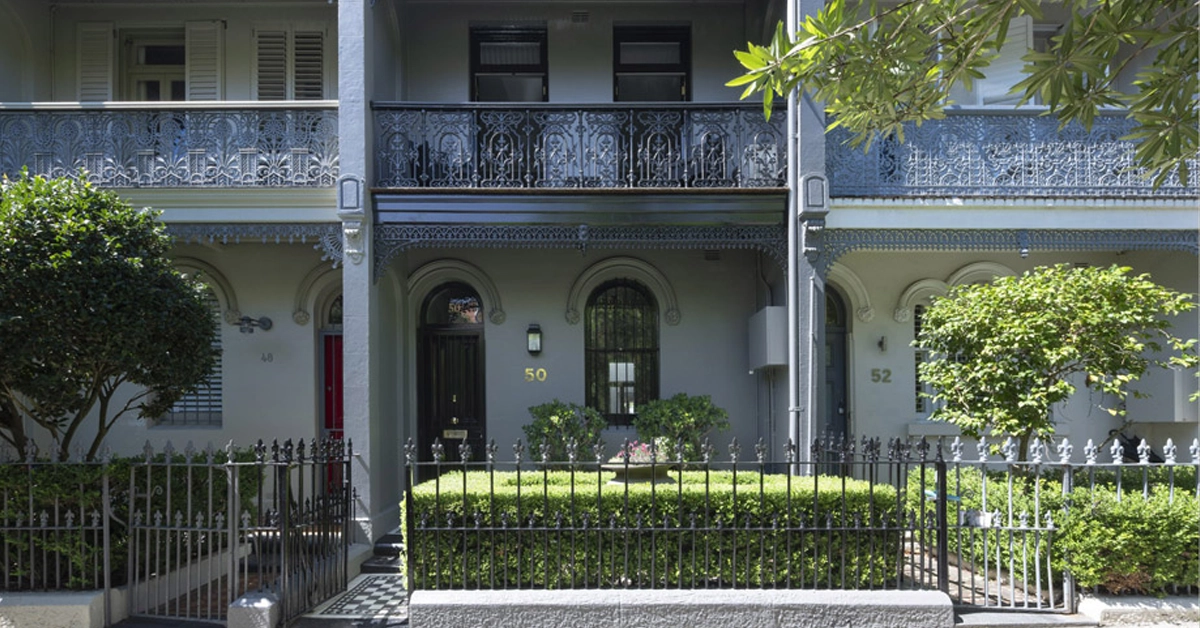
Walk down any of Paddington’s characteristically hilly streets and you’ll see the terrace house in its full glory — the cast-iron lacework, the painted rendered facades, the narrow blocks tumbling down toward the harbour. For many locals, these are simply home. For NSW’s housing planners right now, they may also be the future.
A style of dwelling that spent much of the twentieth century falling out of favour has been thrust back into the spotlight. The NSW Government’s Housing Pattern Book, which launched in July last year, includes terrace designs among a suite of low-rise options intended to help the state meet a growing housing shortfall — and architects, economists and urban planners are increasingly making the case that the humble terrace deserves a serious second look.
Old bones, new thinking
Paddington-based architect Madeleine Blanchfield knows the terrace well. Living and working in a suburb that is essentially built from them, she sees the form’s appeal in human terms: the way the houses sit close together on a walkable scale, the street life they encourage, the trees that line the footpaths. The terrace, she says, creates neighbourhoods where people are genuinely present to one another.
That said, she’s clear-eyed about the limitations. Orientation matters enormously. A north-facing block can yield a bright, comfortable home; a poorly oriented steep block is a different proposition entirely. The challenge with the Victorian terrace as originally built was never really the form itself, but the way that form interacted with climate and site.
This is precisely the problem the new generation of terrace design is trying to solve. Rather than importing the English terrace wholesale — dark front rooms, services tacked on at the back, little relationship between inside and out — contemporary architects are reworking the layout from the ground up. The Carter Williamson design for the pattern book, for instance, places bathrooms and laundry at the centre of each home so that the living areas can open directly onto a rear garden, while internal courtyards and skylights draw light into what might otherwise be shadowy corridors.
Sydney-based architect Eva-Marie Prineas of Studio Prineas, who renovated and lived in a Victorian terrace with her family, says the form offered something that apartment living simply doesn’t replicate: a grounded garden where you can grow things, keep chickens, and feel connected to the earth beneath you. That’s not a trivial thing in a city where so many residents are squeezed into high-rises with no outdoor space to call their own.
A “missing middle”
The timing of this terrace revival isn’t accidental. Sydney is in the grip of a housing affordability crisis that has become something of a generational emergency. A Grattan Institute report found that Sydney has lost 35,000 residents aged 30 to 40 between 2016 and 2021 — young families and professionals effectively priced out or pushed to the urban fringe.
The institute’s report argues that allowing three-storey townhouses and apartment developments on all residential land, and six-storey developments as a default around major transport hubs, could lift housing construction by up to 67,000 homes a year, cutting rents and house prices by around 12 per cent over a decade.
Grattan economist Brendan Coates, who co-authored the report, described gentle density options — terraces and townhouses — as the missing piece of the puzzle, noting that three-storey townhouses were among the most commercially viable options in Sydney’s established suburbs but that NSW planning reforms had not adequately provided for this type of housing. The Grattan report also found that Victoria’s planning reforms have been more ambitious than those in NSW, particularly when it comes to gentle density.
Paulo Macchia, director of design governance at Government Architect NSW, has noted that the terrace’s old reputation as a substandard housing form says more about how neighbourhoods changed over time than about the merits of the form itself. His argument is that gentle infill — developing perhaps five per cent of properties on a given street — allows density to increase without fundamentally altering what people love about a suburb. The street remains recognisable; the community remains intact.
Paddington’s complicated relationship with the wrecking ball
For Paddington residents, the conversation about terrace preservation carries real historical weight. By the early 1960s, a growing heritage movement had taken root in the suburb, culminating in the founding of the Paddington Society in 1964 — likely the first resident action group formed anywhere in Australia.Around 1910, terraces had fallen out of fashion and much of the area had come to be considered a slum; it wasn’t until after World War II that residents began moving back and restoring the decaying homes.
The green bans of the early 1970s were perhaps the most dramatic chapter in this story. Jack Mundey led the NSW Builders’ Labourers Federation in a campaign to protect Sydney’s built and natural environment from what the union regarded as excessive and inappropriate development. Between 1971 and 1974, 54 bans were imposed across NSW, protecting inner-city suburbs and historic buildings from demolition. Mundey, who passed away in May 2020, never lived to see the terrace transformed from a housing type his movement helped save from the bulldozer into a model being championed by government planners.
Builders put up around 3,800 houses in Paddington between 1860 and 1890 , and those streets of terraces became the suburb’s defining character. The heritage conservation status of Paddington — its streets, houses, rooms and details — is today recognised as being of national and state significance. The suburb is now one of Sydney’s most expensive postcodes, a far cry from the slum label it once carried.
What the pattern book actually offers
The NSW Housing Pattern Book design competition, held between August and November 2024, attracted 212 entries from Australia and around the world. The jury selected five professional winners and one student winner across terrace and mid-rise categories.
The pattern book offers eight architect-designed templates for terraces, townhouses, semis and manor homes — the so-called “missing middle” housing types that sit between detached houses and high-rise apartment blocks. Designs submitted via the pattern book qualify for a streamlined ten-day Complying Development Certificate pathway, significantly cutting the time and complexity of getting a project off the ground.
The designs themselves address the classic criticisms of terrace living. CarterWilliamson’s Terrace 01 design achieves a seven-star NatHERS rating for thermal performance, using passive design techniques to welcome light and warmth, and offering protection from direct sunlight depending on orientation.
Conrad Johnston of Studio Johnston, which contributed the manor house design to the pattern book, has observed that modern terrace design has found workable answers to the old problems of dark interiors — central courtyards, skylights, and a more considered approach to width and layout can produce homes that feel genuinely spacious and liveable, without the controversy that tends to follow larger apartment developments.
For Paddington, the conversation about the terrace’s future is also, in a way, a conversation about the suburb’s past — and about what kinds of communities Sydney wants to build for the generations that come next.
Published 28-February-2026